We've all been there. We've had all our fair share of experience dealing with the nuisances of the airport. Walking miles with heavy bags through the airport, waiting endlessly to get through security, paying overpriced foods in the terminals, waiting hours more for delayed or cancelled flights, or even competing for others for the use of the only outlet at the gate. Needless to say, I think we can all agree that airport adventures are not fun. They are annoying and frustrating and it just makes us feel like the sooner we get out of the airport the better. But now imagine having to actually live in the airport. Like literally sleep, eat, and even bathe in the terminal itself. Most of us can hardly handle a couple of hours stuck in the airport let alone live in one. Well if you have troubling envisioning it, The Terminal will help do it for you.
The above clip is the trailer for The Terminal. This 2004 film was directed by Steven Spielberg (Saving Private Ryan and Jurassic Park) and is about an Eastern European man who is forced to live in the terminal of John F. Kennedy International Airport due to inaccessibility to the U.S and his own native country. Tom Hanks (Forest Gump) plays Viktor Navorski who has just arrived in JFK airport in New York City from a fictional country named Krakozhia. However, during his flight, a military revolution started in Krakozhia making the United States unable to recognize it as a nation anymore. This, in turn, makes Viktor's passport unacceptable due to the revolution, which also makes him unable to enter the U.S (outside the airport), or even return back to Krakozhia. Therefore, he is forced to stay in the terminal of the airport until the revolution ends. Barely even able to speak English, Viktor must literally live the airport life and learn about America solely through what he has access to in the terminal and the people he meets.
Viktor Navorski
This movie is by far one my favorite Spielberg movies. It may even be one of my favorites in general. It's a satirical piece that really uses characters and the airport as basically a giant metaphor. What I love most about this movie, is its ability to send a message to the audience. The story was very well-written and the whole scenario of the film sends a blatant moral at the end of the movie about patience and waiting. Spielberg cleverly uses the context of airport life and createa story to basically make an ironic statement about the way businessmen, travelers, and tourists rush all over to catch a flight. Speaking of Spielberg, this film has definitely brought worth to his credibility as a director. Looking back at some of his prior movies with Saving Private Ryan, Schindler's List, or A.I, he has this amazing talent to make very touching and meaningful dramas. The Terminal is no exception because he is able to create multiple stories within the movie, whether it be Viktor's struggle to get to America, learn english, or fall in love, and blend them together to make a masterpiece for the audience to feel very emotional for.
Amelia Warren
If you look at my last post, I reviewed Angels and Demons starring Tom Hanks. Well he just happened to be in this movie as well. But instead of genius professor who saves a city, he plays a foreign middle aged mad with broken english hardly knowing anything about the U.S. Like I said before, Tom Hanks can play a serious role very well when he needs to be which is very appropriate for this movie. However as a comedy piece too, he needed to show his ability to make the audience laugh as well, and the thing is he did. Hanks was, in my opinion, phenomenal in this movie because he manages to make the audience laugh and weep even while faking an impressive Eastern European accent. This isn't the first time he has done this either. In Forest Gump, he showed exceptional acting with his southern accent and also in Catch Me If You Can with his Boston accent and still demonstrate his comedic and serious acting skills in both movies. The other star featured in this film is Katherine Zeta-Jones (The Mask of Zorro) who plays Amelia Warren, the flirtatious round-the-clock stewardess who spends almost just as much time in the airport as Viktor who she also begins a growing relationship with. Now I've only seen a couple of her films like Chicago and Ocean's Twelve, but even in comparison with those movies, her acting is pretty predictable. She manages to be in a role where her character always has to be the sexy type and the bad girl in a kind of way. She still does a good job playing her part in The Terminal being able to act very seriously and romantically, but her acting is definitely limited nonetheless especially for her potential.
Viktor's friends
Now the cinematic elements were obviously very crucial for this film. You can tell that Spielberg made sure that every angle, shot, and use of lighting was appropriate for specific scenes. Unlike the past films I reviewed, this films is very family friendly and isn't dark at all. The whole setting of the movie was a well-lit airport terminal so the overall lighting of the film was happily bright and crystal clear. This was obviously used to show very simple comedic and plot developing scenes in an easy way. The only rare dim or dark shots were scenes where the mood was very toned down and serious and required the audiences' immediate attention to the dialogue and character expression. The camera angles used ranged from extreme long shots of the airport to close up shots of characters. It was pretty basic still camera work with no necessity of exaggerated movement.
A very memorable moment of the movie was the date scene. In the movie, Viktor and Amelia have gotten to know each other long enough for Viktor to ask her out to dinner. However due to the circumstances of his situation, he has no choice but to take her to out to eat only in the airport itself. So, he and his friends cleverly set up a romantic and beautiful dinner table on the balcony over looking the runways where he and Amelia can formerly enjoy a date. Throughout their little date, Navorski is trying his hardest to impress Amelia and Amelia is trying her hardest to keep her focus away from work (hence the constant beeping from her pager) all the while Viktor's friends that he met in the airport service them to help Viktor. This scene is a very important scene both for the story and the message. Within the dialogue exchange, Amelia tries to have an interesting conversation with Navorski about history but is frustrated when she is interrupted by her work which makes her give up on the date after her confession about her life slipping by and how she's "waiting" for the right moment to change it. Aside from the humorous entertainer in the background for comedic relief, this scene mainly focuses on the character development of Amelia and explains her life which, in turn, also foreshadows the main message of the movie. It helps us as the audience understand her situation more and her connection with the main character, Viktor. The scene essentially only uses 3 simple shots between close ups of Viktor, Amelia, and a long shot of the dinner table to make the audience pay more attention to their dialogue. The music in the background is also very mellow, quiet, and sad to set an emotional mood. The editors did a very good job but most of the credibility behind this scene is definitely the writing.
The video below shows the scene but for some reason cuts off Amelia's story explanation, and Viktor's confession. So if you want to know what happens with them, just watch the movie. It's good, trust me.
The Terminal is definitely one the most underrated movies for both Spielberg and Hanks. I really enjoyed this movie and the more I watched it, the more I really began to understand it and appreciate the whole structure of the film. The movie was both cleverly and beautifully made which makes the film very touching for anyone who watches it. It was also able to use multiple layers of stories differing in styles and mood to create a movie that people can laugh and cry at. The only issues I had, if there really were any, were that some of the scenarios and scenes in this film are not very realistic at all making some parts of the plot questionable. But overall, I don't really have many bad things to say about this film. It's a very well-written and well-made piece of film and I could confidently give it a 9/10.
Vatican City is one of the most renown and historical cities in the world located within Rome, Italy. It is home to some of the world's most spectacular monuments and buildings that represent art, religion, and history. And of course, it is also the capital of the Catholic faith where the pope himself lives. It truly is a remarkable and symbolic city and from what I also hear, it's quite a popular tourist site as well. However, what if there was more to the Vatican than the world knew? What if there are hidden secrets and a lost history that the Vatican had tried to lock away for reasons unknown? Well, if you're just as curious as I was, then Angels and Demons will show you the famous city like you've never experienced before.
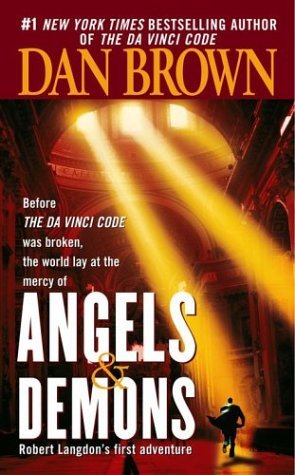
Novel Cover
The above clip is the official trailer. Based on the Dan Brown book with the same name, Angels and Demons takes the very eternal dispute between science and religion to a whole new level. I've read the book and watched the movie and I've got to say they were both very entertaining despite how different they surprisingly were. This 2009 film directed by Ron Howard (A Beautiful Mind and Apollo 13) follows the symbology/history professor, Robert Langdon, in his dangerous journey to help stop a devastating terrorist plot against the Vatican during the Papal Conclave or the electing of the new pope. In a race against time, Langdon, played by Tom Hanks (Forest Gump), must rediscover a secret ancient trail within the city to fight terror with knowledge and stop one of the world's worst cataclysms ever. The movie starts out with a group of nuclear researchers creating large amounts of anti-matter. Meanwhile the Vatican mourns over the sudden death of the pope and prepare for Conclave. Soon the leading nuclear researcher is murdered and a container of the antimatter is stolen threatening to cause a near-nuclear explosion. The Vatican eventually finds that an ancient brotherhood known as the Illuminati have stolen the anti-matter and kidnapped the 4 likely canditates of the next pope planning to kill them one by one and destroy the city with the anti-matter.
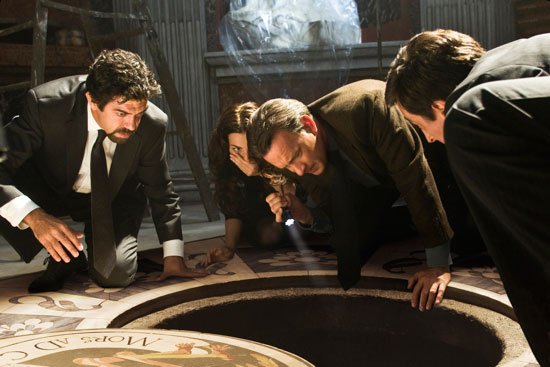
Illuminati (Ambigram)
Vatican City (St. Peters Square)
What's really interesting about this movie is its ability to keep a constant mood of suspense. It's one of those movies that keep you on the edge of your seat until you can settle down with a conclusion. Ron Howard did an exceptional job with this style of suspense and I'm not surprised. Looking back at his movie Apollo 13, it nearly kept the adrenaline going of every audience member throughout the movie, and this piece was not so different. The way the story uses a countdown to a final climax made it very easy for Howard to take advantage of in terms of creating a suspenseful and mysterious setting.
Professor Langdon
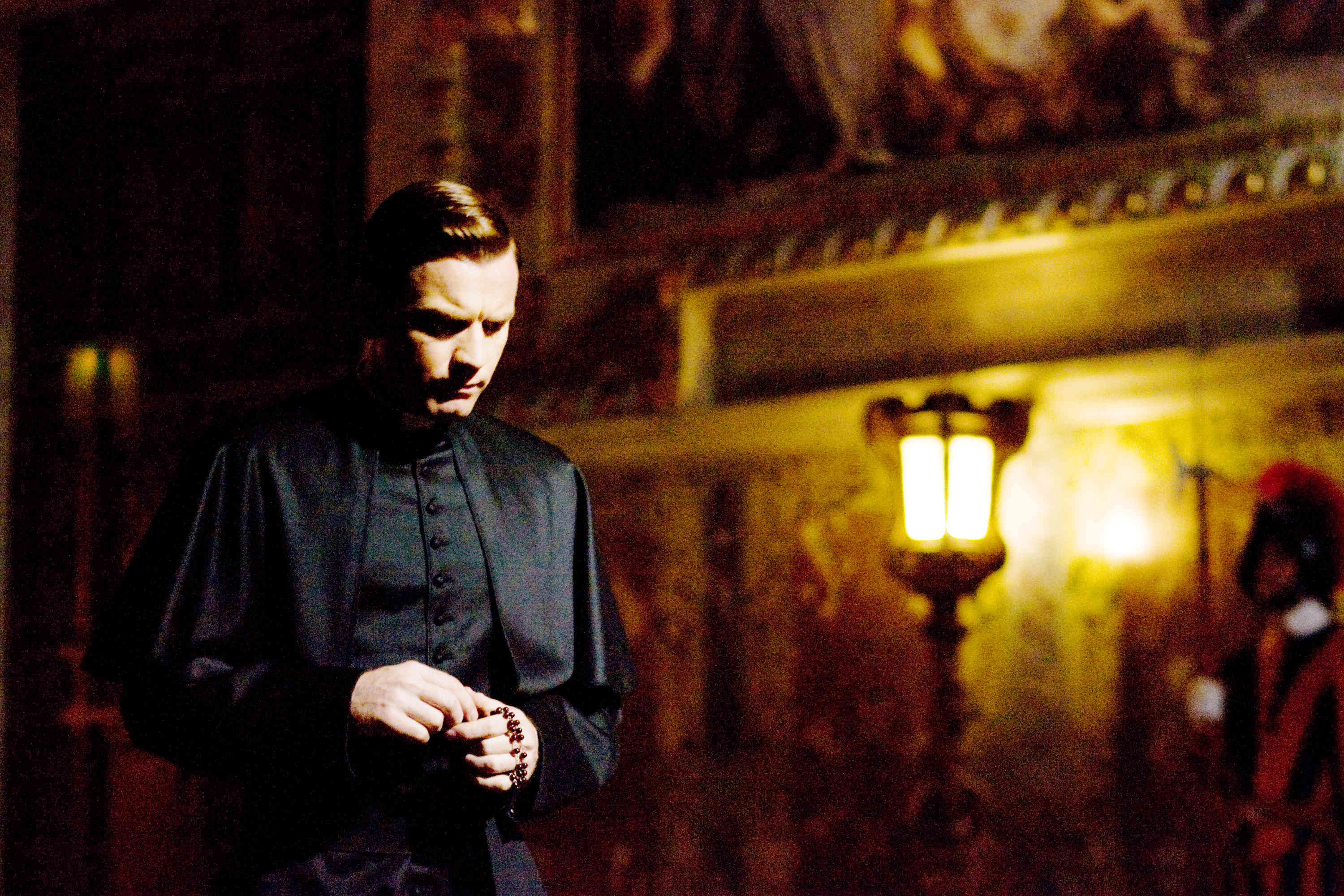
Looking at the cast, I was actually rather pleased with the fact that Tom Hanks played the part of the professor. Something about him gave off a kind of intellectual vibe from the movie and the way he is able act made him a good part as a knowledgeable professor. He can play a serious role very which is exemplified in his characters as Captain Miller in Saving Private Ryan and as Forest in Forest Gump. Plus again with suspense style, you can tell he is able to act accordingly too as shown also in Apollo 13. Ewan McGregor is also a star in the film playing Camerlengo McKenna, the temporary head of the Vatican during Conclave. He plays his part rather well too, although, he as an actor has never really made a large impression on me. To me, he seems more like a mediocre gets-the-job-done kind of actor where you appreciate his character but don't really appraise his skills as much as he probably deserves. I felt that way about him in his role as Obi-wan in the Star Wars series and Grimes in Black Hawk Down. Having said that, however, he did show some unique expressions and character in this particular movie especially near the end which I rather enjoyed.
Camerlengo McKenna
The movie itself, like I mentioned before, focuses mostly on suspense. So in terms of cinematic elements, the camera work was literally very shaky. The way the plot moved was very fast-paced and only really slowed down when there was serious and important dialogue between characters. One thing very spectacular about this film was its use of extreme long-shots to display much of the beautiful Vatican City with its incredible architectural buildings and churches and plazas. The movie also showed great use of long shots and close up shots to focus on specific objects like statues, art, and the character's expressions in certain situations. These shots were key in the plot because as the audience, we were following the viewpoint of Robert Langdon and how he sees his clues and solves his puzzles. The movie was rather dark both literally and figuratively so the lighting mostly involved low-key lighting on the characters and objects especially in church scenes where the aura is rather eerie and mysterious with a hint of suspense.
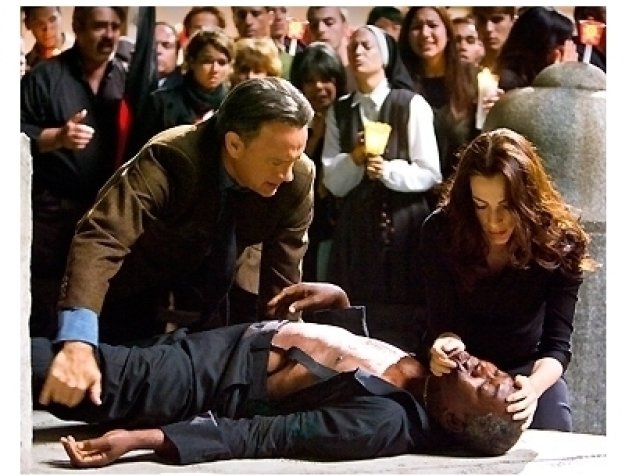
One scene I'd like to focus on is the scene where Professor Langdon and Vittoria, the nuclear researcher, are desperately looking for the Illuminati terrorist in St. Peters Square. They know the Illuminati will kill the next pope candidate in the Square according to the secret ancient trail they were following. However, because of the situation with the deceased pope and the Papal Conclave, the Square is filled with massive amounts of people making it very difficult to locate the killer or the candidate. Soon, the scene shows a young tourist girl drop her doll on a pool of blood from the wounded Cardinal. Her screams bring attention to Langdon and the police where they discover the injured Cardinal dying from a punctured lung and the ambigram "Air" branded on his chest. After a failed CPR attempt to save him, he dies on the floor of the Square. This scene is a very good representation of the movie as a whole because it involves a lot of suspense and mystery. In context, the audience would be on the edge of the seat looking just as hard for the candidate as Langdon only wishing they could save him in time. The scene shows lots of long shots showing the masses of people and quickly switching with close-up shots of Langdon and Vittoria to show their desperate expressions of finding the killer. This is a unique technique where it'll show setting and character back and forth to make the audience see in the characters' views. The way the scene was edited was very fast-paced making us seem like we are struggling to find the killer too. This adds much suspense as does the music in the background which gradually gets more intense until the climax of the scene where we find the dying Cardinal. Along with the dark lighting, quick shot changes, and use of discontinuity editing, we are forced into a mood of suspense and mystery which is exactly what the scene and movie intended to do.
Click Here for a link to the scene (It's slightly bloody though so be warned).
Ambigram example
What I loved about this movie was that it was entertaining and interesting all throughout the film. I thoroughly enjoyed learning about history, appreciating art and architecture, and following a fantastic story. The book had the same effect but the movie definitely gave it that visual aspect that I love. The ending was phenomenal as well although it was somewhat strange and unreasonable, but I won't give away anything here. But I'll just say it's one of those movies that left a pretty impressionable finale for the audience. The problems I kind of had with this movie was that it was pretty unnecessarily gory and disturbing at times and it can get very confusing very quickly if you don't pay attention. At some parts I had to rewind to try and understand the dialogue exchanges between the characters and sometimes they would mumble, be quiet, or talk really fast so it sometimes got annoying. The movie does a good job of using just the right amount of comedic relief and also uses very neat special effects to make that action genre of film. Plus, just as a fun detail, I really loved the whole ambigram concept the plot used where a word design is the same thing upside down and right side up. Definitely one of the most interesting things about the story. Anyways, overall, I really enjoyed it and it is definitely a great film for first-time viewers. For this movie, I'd have to give it a solid 8/10.
Far Away Love is about a young American soldier sent to the trenches in France of the First World War. While there, he meets a lovely young French girl who lives in a farm near the battlefield. Together they fall in love but the war makes it difficult for them to live happily ever after. Hoping to protect her and her family's farm, the American soldier vows to fight and return in the trenches in hopes of keeping the enemies from nearing the French girl's farm. However, worried over his safety, the French girl follows the American into the trenches in hopes to protect him but gets caught up in the crossfire and from there the American must protect his one love during the worst possible situation. The style for this movie will focus on continuity editing with stable shots to get clear dialogue for the love story at least until the climax of the movie. The message will be a simple romantic moral showing that love has no boundaries.
The genre of the film will be a Romance/War/Drama. This is mostly because we don't have much technology to create full scale battle scenes along with the limits of the Hay's code, and so we the romance story will attract the audience. It especially will help with a war environment because it'll add suspense and it's a good reference that everyone is familiar with so it'll help a lot with this original story. As for our cast, the actors and actresses are most experienced in drama type movies.
The studio that would be best to produce this movie is the MGM. Because this movie will be a big scale and big budgeted film, we need a large studio like MGM to support the movie. Plus MGM has produced film in the drama genre which will definitely help us and all the actors we will use are from MGM.
Clark Gable
For our leading roles, we had Clark Gable as the American soldier, and Greta Garbo as the French girl. For our supporting roles, we used Joan Crawford, Fred Astair, and Robert Montgomery. All these actors are signed up already with MGM so it was very convenient to not have to trade for certain actors. Gable and Garbo have had clear acting experience in drama and would be perfect for the romantic couple. Our director of the movie is Victor Fleming who has directed several romance and drama films that would be very beneficial for our story. Because our actors are not in reasonable age for their specific roles, we will focus on make-up and costume. William J. Tuttle will be in charge of this focus since he is the leading make-up artist that MGM. He will be responsible to make the actors realistic for their characters' ages and appropriate for the settings of the film.
The Hay's Code affects our movie in terms of violence and sex. Therefore, we made our film to show no extreme violence from battle scenes but still show war-like environments like the trenches and other soldiers. We also decided that it should be okay to show minor shooting but no killing. For the romance part of the film, we could not include any kind of sexual content or nudity so we would focus more on the romantic aspect and their enduring relationship. For technology, we will be able to simulate a more realistic feel for war with the use of props and controlled blanks for gunfire along with the help of simple camera angles and shots.
If I had sole control over this film, I would probably change some of the actors to best fit their specific roles instead of trying to rely on a make-up artist to force a perspective. I would probably also use an actress for the leading role of the French girl who actually knows French and hopefully shoot the movie in a good area for landscape and warfare.
World War 2 is considered the worst human led catastrophe that occurred in history. With over 60 million people killed from the war, there's no doubt how this devastating era has influenced the film industry since right after the war to even this day. There are literally countless of movies and films portraying the Second World War in some way within the past 70 years especially from the U.S. Recently, I've watched three American films of the World War 2 genre: Schindler's List,The Dirty Dozen, and Letters from Iwo Jima.
As a fan of war films, especially WW2 films, I've seen a wide range and variety of these movies from different time periods and different countries. The thing about WW2 films in particular though is that you can see the style and message change throughout the decades. After the war ended around the 60's to 80's, most of the WW2 films were interestingly pro-war. This was to basically add to American patriotism and celebrate America's victory and triumph over this global conflict. However, it wasn't really until the late 80's into the 90's when WW2 started to become depicted as a more sorrowful and mournful tragedy that shouldn't be celebrated at all but rather send the message of anti-war. In fact, I'd say that it was Steven Spielberg who actually started this anti-war message/style in his WW2 films starting with Schindler's List. And to this day, I feel that his influence on the genre has changed the way WW2 movies are made compared with the ones made 40 or 50 years ago.
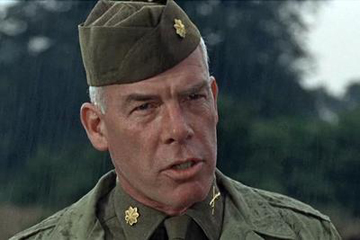
Major John Reisman
The first film I would like to talk about is The Dirty Dozen. This movie was made in 1967 directed by Robert Aldrich and based on the novel with the same name. The movie is about 12 convicted felons sentenced to incarceration, labor, or death who are given the choice to join and train for a top-secret mission just days before the D-Day invasion in France. Major John Reisman (Lee Marvin) is assigned to be in charge of training these men and lead this dangerous mission into German occupied territory. Because this film was made in the 60's, it tended to be more pro-war and give a kind of "Go America" vibe. I could tell because there tended to be a lot more comedic relief and the acting was not nearly as serious as more modern war movies. The special effects were pretty basic as they used controlled explosions and standard props for their weaponry and military equipment. It was definitely good enough to depict a realistic WW2 setting.
Oskar Schindler
Moving on almost 30 years later is Schindler's List directed by Steven Spielberg. This 1993 piece depicts the very wealthy Oskar Schindler (Liam Neeson) who is a German business man of the Nazi party. However, unlike the other nazis, Schindler used his power, status, and money to protect Jews from being abused and killed by the camps and nazi officers. I'm sure most of you have heard of this movie and have heard good things about it. Well I'm not surprised. It won 7 academy awards including best picture, best director, and best score. This movie, in my opinion, marked the anti-war genre for WW2 movies and Spielberg did a very good job of sending that message. Unlike the Dirty Dozen and Letters from Iwo Jima, there were no battle scenes in this movie but there was still lots of killing. The movie focuses more into the holocaust aspect of WW2 rather the military aspect which makes it very unique. It really gave a realistic and graphic perspective of Jewish persecution and massacres during this time. Liam Neeson (Taken) plays Schindler and plays the part perfectly. I'm surprised this isn't the first movie people associate him with because his acting was very impressive along with the rest of cast. They all made the mood of the movie very heart-wrenching. According to the Chicago Tribune, the way the movie was edited was particularly aimed to demonstrate the horror of helpless people at the mercy of authoritative power (Chicago Tribune Review). Surprisingly, Spielberg decided to make this movie in black and white instead of color which I believe makes the tone more serious and the mood much darker. It definitely makes the audience feel more nostalgic and reminisce more about the holocaust which is what I think Spielberg tried to do. If you haven't seen this movie, it's a classic, but it is very graphic and disturbing at some parts, which also happens to add to Spielberg's anti-war message.
General Tadamichi Kuribayashi
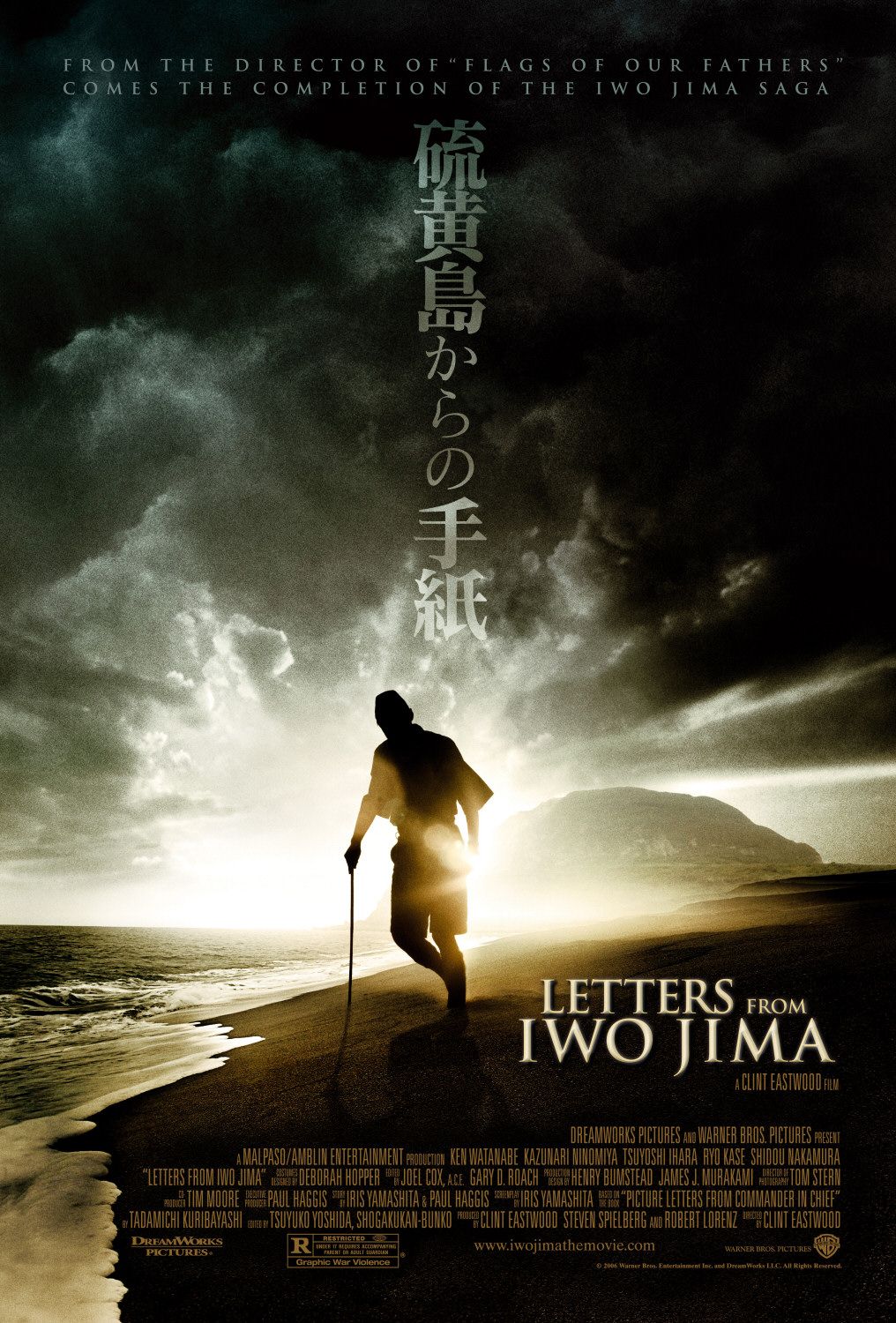
The final movie I watched was Letters from Iwo Jima. This movie was directed by Clint Eastwood as sort of sequel to his Flags of Our Fathers. Letters from Iwo Jima is a 2006 film portraying the Japanese perspective of the infamous battle of Iwo Jima island (interestingly enough contrasts Flags of Our Fathers which shows the American side). The movie follows the struggle of drafted Japanese soldiers and their highly respected General Tadamichi Kuribayashi (Ken Watanabe) defending a piece of their homeland for the first time in the war. Throughout the film, the characters of the movie are constantly writing letters to their loved ones back in the Japanese mainland about their experiences in the war. Eastwood does a spectacular job of showing the Japanese perspective of the war to sort of show that war affects us all even for our enemies. The acting is also very good with Ken Watanabe (Inception) playing his role as the general with passion and seriousness. By this point of the film industry in regards to WW2, the movies have shifted from anti-war to more reminiscing the events. They serve more to be memorials as piece of film instead of a political message. Here, Eastwood shows the cultural and environmental factors that led to the outcomes of battle and uses detailed and insightful character development to make the audience feel for the soldiers and their families regardless of which side of the war they were on. In terms of technology, it's clear that CGI has made the battle scenes much more realistic, eye-opening, and graphic to get a real representation of war for either side which definitely helps add to the mood of the movie.
What I noticed about these movies is that they all have different ways of depicting death and their intent of how the audience should react. In The Dirty Dozen, the battle scene clearly shows deaths on the American side and wants the audience to feel somewhat sorry and sad about it, but you can tell that's not a major focus. For example when one American soldier was shot by a sniper, it just shows him dying with some fake looking blood and poor acting skills. There wasn't any music to add any emotional effect, and the cut was only seconds not giving any time at all for the audience to feel anything for his death. This happens a lot throughout the movie because the director was trying to make the audience focus more on how Americans were winning the fight. In contrast, Schindler's List portrays death as the main strategy to scare and move the audience. There was one scene where Schindler goes to a field where the nazis are burning Jewish corpses into one enormous cremation. In this scene you see Schindler's utter disgust and despair as his reaction and shots of the bodies being tossed and burned makes the audience pay attention to how horrible this was. In Letters from Iwo Jima, the death scenes were much sadder too but they got to a more personal level. Schindler's List would take death on a large and populous scale to make the audience wrench, whereas Letters from Iwo Jima also did that and made the audience have an emotional connection with the main characters and then feel mournful when said characters would die. One example of a mass death was with the suicide scene where hopeless Japanese soldiers commit suicide in a cave based on their code of honor of death over surrender. This is probably one of the most powerful scenes of the movie with the same purpose and effect as the Jewish cremation scene. Then there is the personal death where one scene shows General Kuribayashi losing life lying next to Saigo, a loyal soldier who is holding him. After an exchange of beautiful dialogue about their final moments and Japan, the general shoots himself leaving Saigo to cry over his death and their defeat.
*WARNING: These videos are pretty graphic, so I wouldn't recommend watching for some viewers*
World War 2 is a very typical and predictable genre for movies. What I mean by this is that depending on which time period that movie was made, you can pretty much already know what to expect. But personally, I really enjoy them. It's very interesting to see how the styles and editing changes throughout the decades and it intrigues me more that there always seems to be countless of stories about WW2 to make a movie about. I thoroughly enjoyed all three of these movies and I intend to continue watching WW2 films as one of my favorite genres.


.jpg)